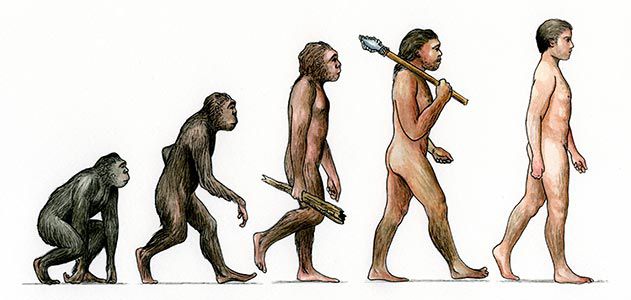
Origin and evolution of man:
- Man is a mammals and supreme among all other animals which exist today.
- Central Asia is the place of origin of man but the fossils of pre-human ancestors are recorded from Africa, Asia and Europe.
- H. Huxley (1863) made the first attempt to explain the origin of man on scientific grounds in his book ‘Man’s place in nature’.
- Charles Darwin (1871) published his ideas regarding man’s ancestry in his book ‘The descent of man’.
- Primitive mammals are said to be evolved from Therapsid reptiles in Triassic period in Mesozoic era.
- First primitive mammals were egg laying prototherians.
Prototheria

Placental mammals (Eutheria) which arose during Cretaceous period
Man like apes appeared during Miocene epoch
Man like forms appeared during Pliocene epoch of Tertiary period in Cenozoic era
Evolutionary characters of man:
- Erect posture:
- Modern man is bipedal, i.e. moves in erect or upright posture on two hind limbs.
- Body trunk is shortened and the limbs are elongated.
- Forelimbs became free, used for different purposes like grasping.
- Hind limbs are elongated more to support the body weight.
- Vertebral column became shorter and stouter which supports the erect trunk.
- Skull shifted on the upper end of the vertebral column, therefore, foramen magnum shifted forward and downward.
- Pelvis became broad and basin shaped to balance the trunk and help in bending.
- The tail is lost.
- Stereoscopic vision:
- Both eyes are situated in front of the head.
- The exact distance of the object can be judged and the images represent a 3-dimensional (3D) picture of the objects.
- Large size of brain:
- Surface area of the brain is increased due to the folding of grey matter.
- Cranial capacity of modern man is about 1450-1500 cc.
- Large size of cerebral hemispheres means higher intelligence.
- Large size of cerebellum signifies better co-ordination between muscles and other organs.
- Less use of sense of smell made the nose small and narrow.