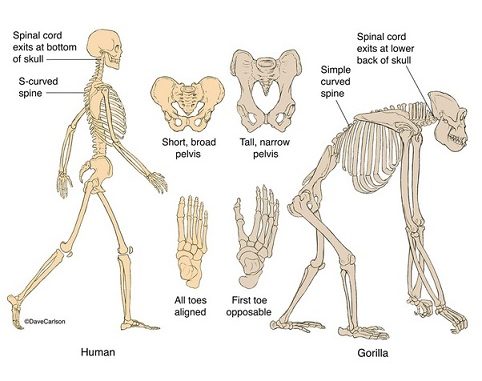
| S.N. | Man | Apes |
| 1. | Mostly lead terrestrial life | Chiefly lead arboreal life (except gorilla) |
| 2. | Walks in fully erect posture after infancy on the soles of the feet | Walks in semi-erect posture on outer edges of feet and knuckles of hands or fore limbs |
| 3. | Legs are longer than arms. | Arms are longer than legs |
| 4. | Pollex (big thumb) is opposable, hallux (the big toe) is not opposable | Both pollex and hallux are opposable |
| 5. | Vertebral column has two forward and 2 backward curves | Vertebral column is arched backward |
| 6. | Pelvic girdle is bowl shaped with expanded ilium to support viscera. | Pelvic girdle has long ilium unfit to support viscera. |
| 7. | Cranium is rounded and the face is comparatively flat. | Cranium is flat and face is protruding. |
| 8. | Brow ridges are lacking and chin is distinct. | Brow ridges are prominent and chin is not distinct. |
| 9. | Cranial capacity is 1200-1600 cc. | Cranial capacity is under 650 cc. |
| 10. | There is no diastema (gap between two teeth) and canines are not projecting. | There is a small diastema between incisors and canines, canines are projecting. |
| 11. | Body has short, sparce (thinly dispersed) hair. | Body is covered with long, thick and coarse hair. |
| 12. | Has the ability to make and use tools, has spoken and written language for communication. | Don’t have the ability to make and use sophisticated tools and also lack spoken and written language for communication. |