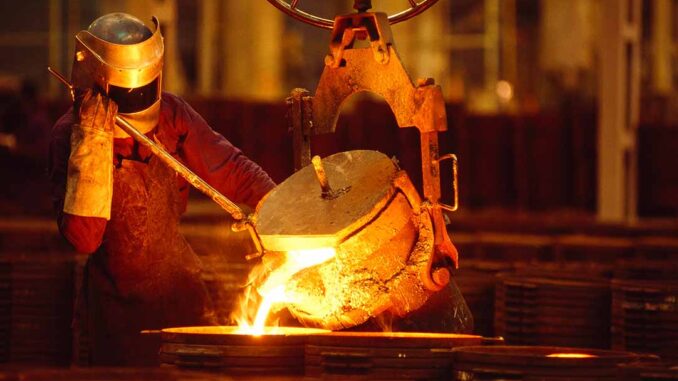
Introduction to Metallurgy
Metallurgy is the branch of science that deals with the extraction of metals from their ores, their purification, and the preparation of useful metal products.
Most metals are found in nature in the form of compounds. These compounds are present in rocks and minerals. A few metals, such as gold, silver, and platinum, are sometimes found in their free or native state.
The process of obtaining a pure metal from its naturally occurring ore involves several steps. These steps depend on the nature of the ore and the reactivity of the metal.
Metals and Their Properties
Metals are electropositive elements that generally lose electrons to form positive ions (cations). They are widely used in industries, construction, transportation, electrical appliances, and household materials.
A. Physical Properties of Metals
1. Metallic lustre: Metals have a shiny surface when freshly cut or polished. For example, gold and silver have a bright metallic appearance.
2. Malleability: Metals can be beaten into thin sheets without breaking. For example, aluminium is used to make aluminium foil.
3. Ductility: Metals can be drawn into thin wires. For example, copper and aluminium are used in electrical wiring.
4. Conductivity: Metals are good conductors of heat and electricity. Copper is commonly used in electrical wires because of its high electrical conductivity.
5. Hardness and strength: Most metals are hard and strong. Iron is used in buildings, bridges and machinery. However, some metals, such as sodium and potassium, are soft.
6. High melting and boiling points: Most metals have high melting and boiling points. However, some metals, such as mercury, have a very low melting point and exist as liquids at room temperature.
7. Sonority: Metals produce a ringing sound when struck. Therefore, they are called sonorous materials.
8. High density: Most metals have high densities. However, metals such as lithium, sodium and potassium have low densities.
B. Chemical Properties of Metals
Metals show different chemical properties depending on their reactivity.
1. Reaction with oxygen. Metals generally react with oxygen to form metal oxides.
2Mg + O₂ → 2MgO
2. Reaction with water. Some metals react with water to produce metal hydroxides or oxides and hydrogen gas. Sodium reacts vigorously with cold water.
2Na + 2H₂O → 2NaOH + H₂
3. Reaction with dilute acids. Many metals react with dilute acids to produce salt and hydrogen gas.
Zn + 2HCl → ZnCl₂ + H₂
4. Displacement reactions. A more reactive metal can displace a less reactive metal from its salt solution. Iron displaces copper from copper sulphate solution.
Fe + CuSO₄ → FeSO₄ + Cu
C. Extraction of Metals from Their Ores
- Mineral: A naturally occurring substance in the Earth’s crust that contains a metal.
- Ore: A mineral from which a metal can be extracted profitably and conveniently. (All ores are minerals, but not all minerals are ores.) Examples of important ores include: bauxite (aluminium), haematite (iron), zinc blende (zinc), cinnabar (mercury) and copper pyrites (copper).
Metals and their ores with chemical formulae
S.N.
Metal Ores (Names and Chemical Formula)
1 Iron (Fe) Haematite (Fe₂O₃), Magnetite (Fe₃O₄), Siderite (FeCO₃), Limonite (FeO(OH)·nH₂O) 2 Silver (Ag) Argentite (Ag₂S), Chlorargyrite (AgCl), Pyrargyrite (Ag₃SbS₃) 3 Aluminium (Al) Bauxite (Al₂O₃·2H₂O), Corundum (Al₂O₃), Cryolite (Na₃AlF₆) 4 Copper (Cu) Copper pyrites / Chalcopyrite (CuFeS₂), Cuprite (Cu₂O), Malachite (CuCO₃·Cu(OH)₂), Azurite (2CuCO₃·Cu(OH)₂) 5 Gold (Au) Native gold (Au), Calaverite (AuTe₂), Sylvanite ((Au,Ag)₂Te₄) 6 Zinc (Zn) Zinc blende / Sphalerite (ZnS), Smithsonite (ZnCO₃), Zincite (ZnO) 7 Lead (Pb) Galena (PbS), Cerussite (PbCO₃), Anglesite (PbSO₄) 8 Tin (Sn) Cassiterite (SnO₂), Stannite (Cu₂FeSnS₄) 9 Mercury (Hg) Cinnabar (HgS) 10 Magnesium (Mg) Magnesite (MgCO₃), Dolomite (CaMg(CO₃)₂) 11 Chromium (Cr) Chromite (FeCr₂O₄) 12 Manganese (Mn) Pyrolusite (MnO₂), Rhodochrosite (MnCO₃) 13 Nickel (Ni) Pentlandite ((Fe,Ni)₉S₈), Garnierite ((Ni,Mg)₃Si₂O₅(OH)₄) 14 Titanium (Ti) Rutile (TiO₂), Ilmenite (FeTiO₃) 15 Calcium (Ca) Limestone / Calcite (CaCO₃), Gypsum (CaSO₄·2H₂O) Note: Some ores, such as bauxite and garnierite, have variable chemical compositions. Their formulas are approximate representations.
1. Mining of Ores
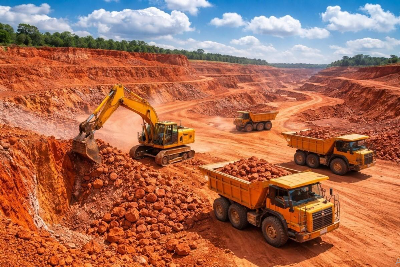
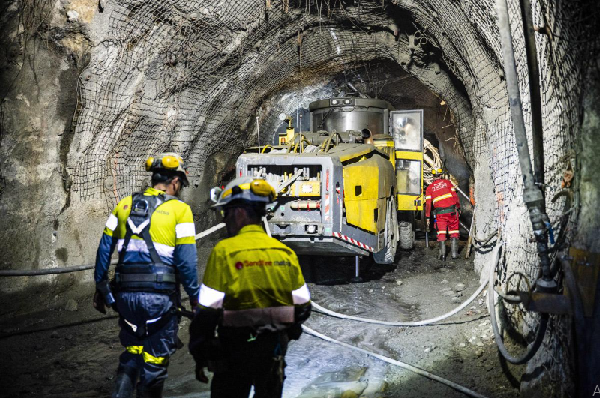
Mining is the process of removing mineral deposits or ores from the Earth’s crust. Ores are usually found beneath the surface or sometimes near the surface of the Earth.
a. Open-cast mining: Ores found near the Earth’s surface are extracted by removing the overlying soil and rocks. Bauxite is commonly extracted by this method.
b. Underground mining: Ores found deep inside the Earth are extracted through tunnels and shafts. Deep deposits of gold and copper ores may be extracted using this method.
2. Crushing and Grinding
The ores obtained from mines usually contain large pieces of rocks. These pieces must be reduced into smaller particles before further processing.
a. Crushing: Large pieces of ore are broken into smaller pieces using crushers.
b. Grinding: The crushed ore is further ground into fine powder using grinding machines or ball mills.
Crushing and grinding help to separate the valuable mineral particles from unwanted rocky materials called gangue.

3. Concentration of Ores
The process of removing unwanted impurities, such as sand, clay, and rocky materials (gangue), from an ore is called concentration of ore or ore dressing. The main purpose is to increase the percentage of the desired mineral in the ore. Different methods are used depending on the physical and chemical properties of the ore.
a. Hand Picking. Unwanted materials are separated from the ore by hand. It is suitable when ore particles and impurities have different appearances, colours or shapes and are large enough to be separated manually. For example, visible pieces of rocky impurities can be removed from an ore by hand.
b. Gravity Separation Process (Hydraulic Washing). This method is based on the difference in densities of the ore particles and gangue particles. The powdered ore is washed with a stream of water. The heavier ore particles settle at the bottom, while lighter impurities are carried away by water. For example, haematite ore can be concentrated by gravity separation.

c. Magnetic Separation. This method is based on the difference in magnetic properties of the ore and its impurities. The powdered ore is passed over a moving conveyor belt near a magnetic roller. Magnetic particles are attracted towards the magnet, while non-magnetic particles fall separately. It is used to concentrate magnetic iron ores such as magnetite.

d. Froth Flotation Process. This method is mainly used for concentrating sulphide ores. It is based on the difference in the wetting properties of ore particles and gangue particles. The powdered ore is mixed with water and a small amount of oil (collector or frothing agent). Air is blown through the mixture. Sulphide ore particles attach to air bubbles and rise to the surface as froth. The gangue particles are generally wetted by water and settle at the bottom. The froth is collected and dried. For example, zinc blende (ZnS) and copper pyrites (CuFeS₂) are concentrated by this method.

e. Chemical Separation (Leaching). This method is based on the difference in chemical properties of the ore and its impurities. A suitable chemical solution dissolves the desired ore selectively, while many impurities remain undissolved. The desired metal compound is then recovered from the solution. For example, bauxite is purified by leaching with hot concentrated sodium hydroxide solution. Aluminium oxide dissolves to form soluble sodium aluminate.
Al₂O₃ + 2NaOH → 2NaAlO₂ + H₂O
The sodium aluminate solution is further processed to obtain aluminium hydroxide, which is heated to produce alumina (Al₂O₃).
4. Conversion of Concentrated Ores into Oxides
After concentration, the ore is usually converted into its oxide form. Metal oxides are generally easier to reduce into metals than their corresponding sulphides or carbonates.
a. Roasting. Roasting is the process of heating a concentrated sulphide ore strongly in the presence of excess air or oxygen. It converts sulphide ores into metal oxides and releases sulphur dioxide gas. For example, zinc blende (ZnS) is converted into zinc oxide.
2ZnS + 3O₂ → 2ZnO + 2SO₂
b. Calcination. Calcination is the process of heating a concentrated carbonate ore or hydrated ore strongly in the absence or limited supply of air. It removes moisture, carbon dioxide and other volatile substances. For example, zinc carbonate is converted into zinc oxide.
ZnCO₃ —heat→ ZnO + CO₂
Similarly, hydrated aluminium hydroxide loses water on heating to form alumina.
2Al(OH)₃ —heat→ Al₂O₃ + 3H₂O
5. Reduction of Metal Oxides into Metals
Reduction is the process of removing oxygen from metal oxides to obtain metals. The method of reduction depends mainly on the reactivity of the metal.
a. Smelting (Reduction using Carbon). Smelting is the process of extracting metals by heating their oxides with a suitable reducing agent, such as carbon or carbon monoxide, at high temperatures. It is commonly used for moderately reactive metals, such as iron, zinc and lead.
Fe₂O₃ + 3CO → 2Fe + 3CO₂
Iron is extracted from haematite in a blast furnace. Carbon monoxide acts as the main reducing agent. Zinc oxide can also be reduced using carbon.
ZnO + C —heat→ Zn + CO
b. Reduction Using Aluminium (Aluminothermic Process). This method uses aluminium powder as a reducing agent. Aluminium has a strong affinity for oxygen. It removes oxygen from metal oxides and forms aluminium oxide. A large amount of heat is released. For example, chromium can be extracted from chromium oxide.
Cr₂O₃ + 2Al → 2Cr + Al₂O₃

This process is also used in thermite welding to join railway tracks.
c. Electrolytic Reduction. Highly reactive metals cannot be extracted easily by using carbon or other common reducing agents. They are extracted by electrolysis of their molten compounds. Metal ions gain electrons at the cathode and form metal atoms. For example, sodium is extracted by electrolysis of molten sodium chloride.
Cathode: Na⁺ + e⁻ → Na
Anode: 2Cl⁻ → Cl₂ + 2e⁻
Overall: 2NaCl(l) → 2Na(l) + Cl₂(g)
Similarly, aluminium is extracted by electrolysis of alumina dissolved in molten cryolite.
6. Refining of Metals
The metal obtained after reduction is often impure. It may contain small amounts of other metals, non-metals and unwanted substances. The process of removing these impurities to obtain pure metal is called refining or purification of metals.
a. Electrolytic Refining. This method is commonly used to obtain highly pure metals such as copper, zinc and silver. Impure metal is used as the anode (positive electrode), a thin sheet of pure metal is used as the cathode (negative electrode), and a suitable solution of the metal salt is used as the electrolyte. When electric current is passed, metal from the impure anode dissolves into the electrolyte and pure metal is deposited on the cathode. Insoluble impurities settle below the anode as anode mud.
For example, impure copper is refined using copper sulphate solution acidified with dilute sulphuric acid.
Anode: Cu → Cu²⁺ + 2e⁻
Cathode: Cu²⁺ + 2e⁻ → Cu

b. Distillation. This method is used to purify metals that have relatively low boiling points, such as zinc and mercury. The impure metal is heated until it changes into vapour. The vapour is cooled and condensed to obtain pure metal. Non-volatile impurities remain behind.
c. Liquation. Liquation is used to purify metals that have low melting points compared with their impurities. The impure metal is heated on a sloping surface to a temperature slightly above its melting point. The pure metal melts and flows down the slope, while solid impurities remain behind. Tin, lead and bismuth can be purified by this method.
d. Oxidation Refining. The impure metal is heated in the presence of air or oxygen. Certain impurities are converted into their oxides. These oxides either escape as gases or form slag, which can be removed. During copper refining, iron impurities may be oxidised to iron oxide. Iron oxide combines with silica to form iron silicate slag.
2FeO + SiO₂ → Fe₂SiO₄