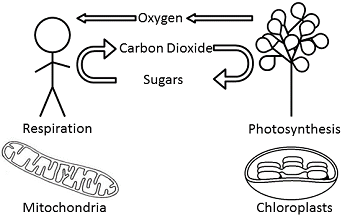
| S.N. | Photosynthesis | Respiration |
| 1. | It is an anabolic process in which simple inorganic substances react to synthesize complex organic food. | It is a catabolic process in which complex organic foods are oxidized or broken down into simpler inorganic forms. |
| 2. | Carbon dioxide is absorbed. | Carbon dioxide is released. |
| 3. | Oxygen is evolved. | Oxygen is absorbed or used. |
| 4. | It occurs in the presence of light. | Light is not essential for this process as it occurs day and night. |
| 5. | It occurs only in green plants. i.e. presence of chlorophyll is necessary for this process. | It takes place in all plants and animals. The presence of chlorophyll is not necessary. |
| 6. | Carbon dioxide and water are used as raw materials. | Glucose and oxygen are used as raw materials. |
| 7. | It is an endothermic process as energy is stored during this process. | It is an exothermic process, because energy is released during this process. |
| 8. | In this process, food is accumulated and dry weight of the plant is increased. | Weight of the plant is decreased due to the oxidation of food. |
| 9. | It occurs in chloroplast. | It occurs in mitochondria. |
| 10. | The end products are glucose and oxygen. | The end products are carbon dioxide and water. |
| 11. | In this process, radiant energy (light energy) is converted into chemical or potential energy. | In this process, chemical or potential energy is converted into other forms like muscular energy, kinetic energy etc. |
| 12. | During this process, one glucose molecule is synthesized and 18 ATP molecules are utilized. | During this process, one glucose molecule is oxidized and 38 ATP molecules are formed. |