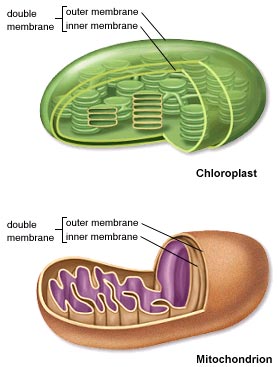
| S.N. | Mitochondria | Chloroplasts |
| 1. | They are smaller in size (1-4 µm). | They are bigger in size (4-10 µm). |
| 2. | They occur in practically all eukaryotic cells. | They occur in green eukaryotic cells which are exposed to sunlight. |
| 3. | They are bin-like in shape. | They are disc-like in shape. |
| 4. | Cristae remain attached to the inner membrane. | Thylakoids remain separated from the inner membrane. |
| 5. | Cristae are formed by the folding of the inner membrane. | Foldings in the inner membrane form stromules. |
| 6. | Cristae produce ATP by breakdown of glucose. | Thylakoids produce ATP by action of light. |
| 7. | They lack pigments. | They have pigments. |
| 8. | They consume organic compounds for their activity leading to decrease in weight. | They produce organic compounds, leading to increase in weight. |
| 9. | They produce CO2 and H2O by breakdown of organic compounds. | They utilize CO2 and H2O as raw materials to synthesize organic compounds. |
| 10. | They use oxygen to break down glucose. by cellular respiration. | They produce oxygen and glucose by photosynthesis. |
| 11. | They are functional all the time. | They are functional only in the presence of sunlight. |
| 12. | They don’t trap light energy. | They trap light energy and convert that into chemical energy in organic compounds. |