The origin of life on Earth and evolution are closely connected, as one explains how life began and the other explains how it changed over time. Life is believed to have started from simple molecules that gradually formed the first living cells. Once life appeared, these early organisms began to vary, adapt, and reproduce over millions of years. Evolution explains how these simple forms of life gradually developed into the diverse plants, animals, and humans we see today. In other words, the origin of life provides the starting point, while evolution shows the process through which life became increasingly complex and adapted to different environments.
Theories of the origin of life on Earth:
- Theory of Special Creation
The theory of special creation states that life on Earth was created by a divine power or supernatural being. According to this belief, all living organisms, plants, animals, and humans were created in their present form and have not changed over time. This idea is found in many religious texts and traditions around the world. Supporters of this theory believe that life appeared suddenly and was not formed by natural processes. However, this theory is not based on scientific evidence and is not accepted by modern science, which requires observable and testable explanations.
- Theory of Spontaneous Generation
The theory of spontaneous generation, also called abiogenesis, suggested that living things could arise suddenly from non-living matter on their own. For example, people once believed that maggots came from rotting meat or that frogs appeared from mud. This idea was popular in ancient times. However, experiments by scientists such as Francesco Redi and Louis Pasteur disproved this theory. Redi showed that maggots only appeared on meat when flies laid eggs on it, and Pasteur’s experiment proved that microbes come from other microbes, not from non-living substances. These findings showed that life cannot arise spontaneously under normal conditions.
- Modern Theory of Origin of Life (Molecular Theory)
The modern theory, also called the molecular theory of the origin of life, is the most accepted scientific explanation today. It suggests that life began about 3.5 to 3.8 billion years ago from simple molecules present in the early Earth’s atmosphere. Scientists believe that energy from lightning, volcanic eruptions, and ultraviolet rays helped simple gases like methane, ammonia, and water vapour combine to form complex molecules such as amino acids. These molecules later joined to form proteins and nucleic acids, leading to the first simple living cells. This idea was supported by the famous experiment of Miller and Urey, who were able to produce amino acids in the lab by mimicking early Earth conditions. This theory explains how life could have slowly developed from non-living matter through natural chemical processes. This theory explains chemical evolution before life started on Earth.

Evidence of evolution:
Evidence of evolution includes fossils, comparative anatomy, embryology, geographical distribution, and connecting links, showing how organisms have changed and adapted over time.
- Palaeontological Evidence (Fossil Evidence)
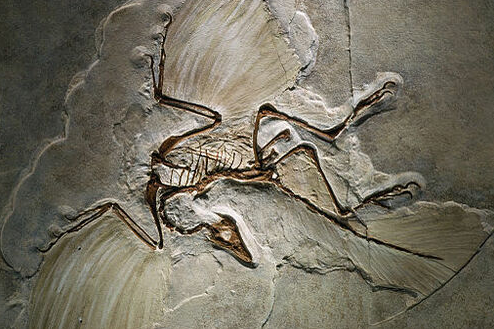
Palaeontology is the study of fossils, which are the preserved remains or impressions of organisms that lived in the past. Fossils are found deep inside rocks and soil, and they give scientists clues about the structure and form of ancient organisms. When we compare fossils from different time periods, we can see how living organisms have changed slowly over millions of years. For example, the fossil record of the horse shows that it was once a small, four-toed animal, and over time, it evolved into the large, one-toed horse we see today. This gradual change seen in fossils supports the idea of evolution.
Source: https://flexbooks.ck12.org/cbook/ck-12-cbse-biology-class-12/section/6.3/primary/lesson/evidences-for-evolution/
- Evidence from comparative morphology and anatomy:
When scientists compare the external structures (morphology) and internal structures (anatomy) of different organisms, it is called comparative morphology and anatomy. Such comparisons reveal similarities and differences among organisms, and these provide important evidence that living beings are related to one another through the process of evolution. Certain types of organs provide very clear evidence of evolution when studied comparatively, and they are: homologous organs, analogous organs, and vestigial organs.
a. Homologous Organs
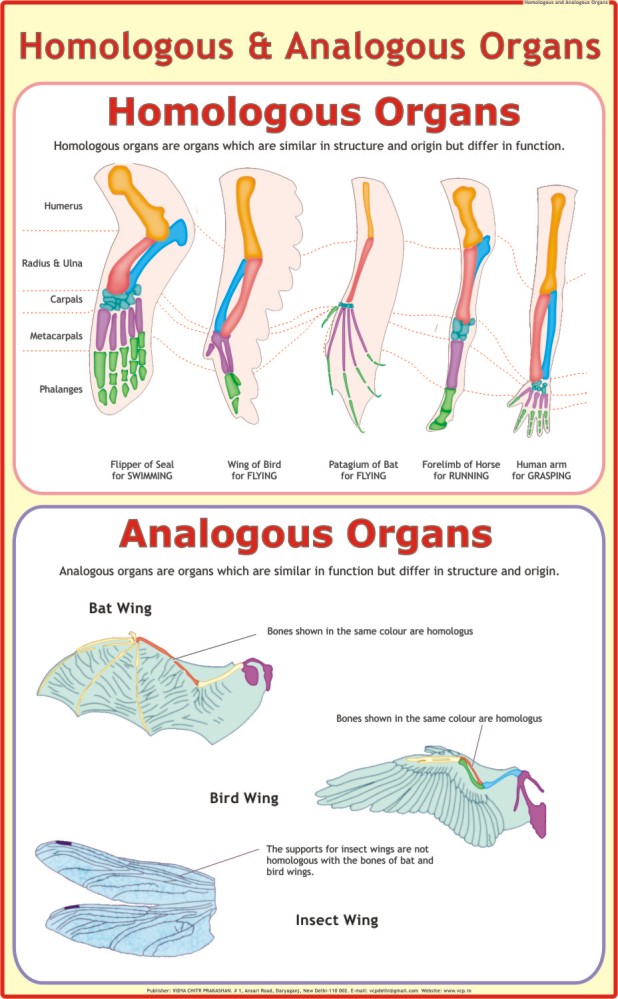
Homologous organs are body parts that have a similar internal structure but are used for different functions in different animals. These organs show that the animals might have evolved from a common ancestor. For instance, the forelimbs of humans, cats, whales, and bats have the same bone arrangement, even though they are used for different activities like writing, walking, swimming, and flying. This similarity in structure, despite differences in function, is a strong proof that these animals share an evolutionary origin. This kind of evolution, where organisms with a common origin develop different forms and functions, is called divergent evolution.
Source: https://vcpmaps.com/product/homologous-and-analogous-organs-chart/?srsltid=AfmBOorD8p2qo4j3qbedt7S5CDQYCiAtNg-SFjCkocL4ofiSUhc8nqi8
b. Analogous Organs
Analogous organs are the organs that perform similar functions but are different in structure and origin. This type of evidence shows that animals living in similar environments may develop similar features, even if they are not closely related. For example, the wings of birds and the wings of insects are both used for flying, but they are built differently. The bird’s wing has bones and muscles, while the insect’s wing is thin and lacks bones. Similarly, the fins of fish and flippers of whales are also analogous organs. This shows that these animals adapted to their surroundings in their own way, leading to the development of similar functions through different evolutionary paths. This kind of evolution, where unrelated organisms develop similar features independently, is called convergent evolution.
c. Vestigial Organs
Vestigial organs are parts of the body that are present in an organism but do not have any important function now. These organs were once useful to the ancestors of the organism but have lost their function over time due to evolution. For example, vermiform appendix, wisdom tooth, canine tooth, nictitating membrane etc., are some vestigial organs in humans. Similarly, some snakes like boas and pythons have vestigial rear legs, whales have small pelvic bones. The presence of such useless or reduced structures shows that living organisms have changed from earlier forms.
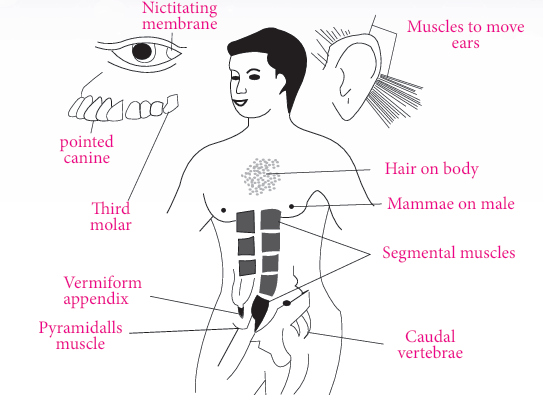
| Vestigial Organs | Function in the Past | Current State in Humans |
| Appendix | Helped in digesting cellulose from raw plant material | Reduced and mostly non-functional |
| Nictitating membrane (plica semilunaris in eye) | Acted as a third eyelid for eye protection and cleaning | Small fold in eye, non-functional |
| Muscles to move ear pinnae (auricular muscles) | Allowed ear movement to detect sounds better | Mostly non-functional; ear movement is minimal |
| Abdominal muscles (some, e.g., pyramidalis) | Helped in climbing or strengthening core for movement | Very weak or absent in some people |
| Male nipples | Originally part of female embryonic development | Present but no reproductive function |
| Wisdom teeth (third molars) | Helped in grinding tough plant material | Often impacted or removed; not necessary for chewing |
| Canine teeth (large in ancestors) | Used for tearing food or defense | Smaller, less prominent; mostly non-functional for defense |
| Body hair | Provided warmth and protection | Very sparse; mostly non-functional |
| Tail bone (coccyx) | Supported a tail for balance and movement | Small fused vertebrae; no tail |
- Embryological Evidence
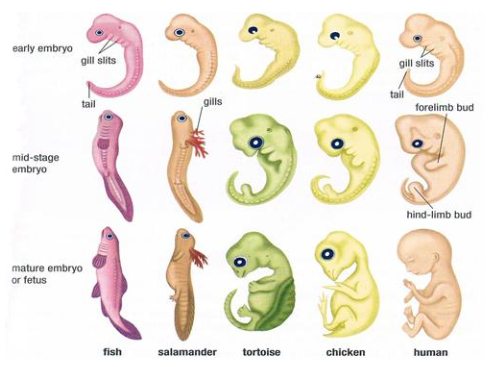
An embryo is the early stage of development of a multicellular organism after fertilization, when a zygote starts dividing and forming tissues and organs. Embryology is the study of embryos and their development from fertilization to birth (or hatching in animals). When we study embryos of different animals, we see that they look similar in the early stages. As they grow, they develop into their specific forms. For example, a mammal’s embryo shows features like those of fish, amphibians, reptiles, and birds at different stages This similarity in early development suggests that these animals had a common ancestor, and their differences appeared only later during growth.
Based on such observations, the German biologist Ernst Haeckel in the 19th century proposed the Biogenetic Law, which states that ontogeny repeats phylogeny. This means, the development of an individual organism (ontogeny) passes through stages that resemble the evolutionary history (phylogeny) of its species. In simple words: “An individual’s embryo goes through stages similar to the adult forms of its ancestors. Thus, embryological evidence helps us understand the evolutionary relationships between different species.
- Evidence from Geographical Distribution
Geographical distribution refers to the way different animals and plants are found in different parts of the world. This pattern shows that species have evolved differently depending on their location and environment. For example, kangaroos are only found in Australia because that continent has been separated from others for millions of years, allowing its animals to evolve in isolation. Similarly, during his voyage on the Beagle, Darwin observed the geographical distribution of organisms. On the Cape Verde Islands near Africa, he found organisms similar to those on the nearby African coast. Later, on the Galapagos Islands of South America, he noticed that although the climate was similar to Cape Verde, the organisms were very different and resembled those of South America. This showed that organisms are more influenced by their origin than by climate.
He also observed that when organisms of the same origin are isolated in different environments, they develop differences over many generations. Geographic barriers like oceans, rivers, and mountains prevent migration and lead to variation and evolution.
- Evidence from Missing and Connecting Links
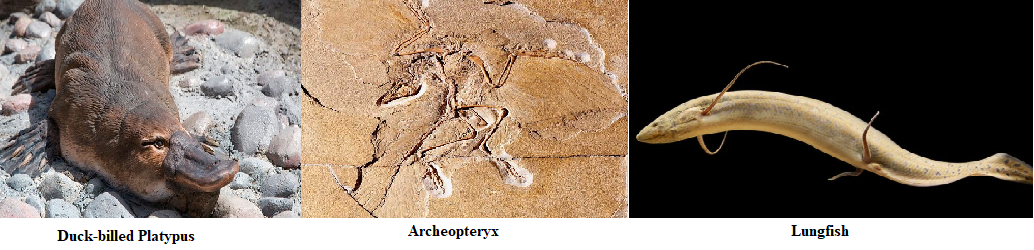
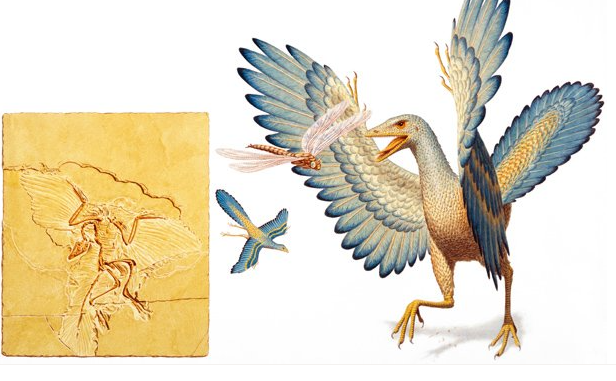
Missing and connecting links are special types of organisms that show features of two different groups of animals. These organisms help us understand how one group of animals might have evolved from another. A missing link is usually a fossil that shows traits of both the past and present animal groups. For instance, Archaeopteryx is a famous fossil that had a beak, wings and feathers like a bird and jaw, teeth and claws like a reptile, suggesting it was a link between the two. A connecting link is a living organism that also shows mixed features, like Platypus and Lungfish. Platypus connects aves and mammals. It has a beak like that of a duck and lays egss like birds and is covered in dense fur and has mammary glands like a mammal. Similary, lungfish (Protopterus) connects fish and amphibians. It has gills, fins, and scales like fish and lungs like in an amphibian. These links provide strong evidence for the step-by-step process of evolution.