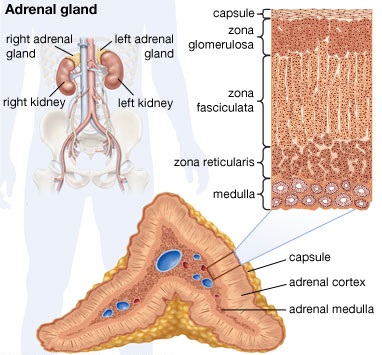
| S.N. | Adrenal cortex | Adrenal medulla |
| 1. | It is the external firm region of the adrenal gland. | It is the central soft region of the adrenal gland. |
| 2. | It is pale yellowish-pink in color. | It is dark reddish brown in color. |
| 3. | It is enclosed by a fibrous capsule. | It is not enclosed by a fibrous capsule. |
| 4. | It comprises about 75-80% of the adrenal gland. | It forms about 20-25% of the adrenal gland. |
| 5. | It develops from the mesoderm. | It develops from the ectoderm (neural crests). |
| 6. | It consists of 3 concentric regions: outer zona glomerulosa, middle zona fasciculata and inner zona reticularis. | It is not differentiated into any regions. |
| 7. | It is essential for life and its destruction causes death. | It’s destruction doesn’t cause death as it is not essential for life. |
| 8. | It secretes 3 groups of hormones: mineralocorticoids, glucocorticoids and sex corticoids. | It secretes 2 similar hormones: adrenaline (epinephrine) and nor adrenaline (nor epinephrine). |
| 9. | It is stimulated to release its hormones by the adreno-corticotropic hormone (ACTH) from the anterior pituitary. | It is stimulated to secrete its hormones by the nerve impulses reaching via sympathetic nerve fibers. |
| 10. | The over/under production of hormones from adrenal cortex causes many disorders like Cushing’s disease, Addison’s disease etc. | It is not yet known to cause any disorder from the over/under production of hormones from adrenal medulla. |